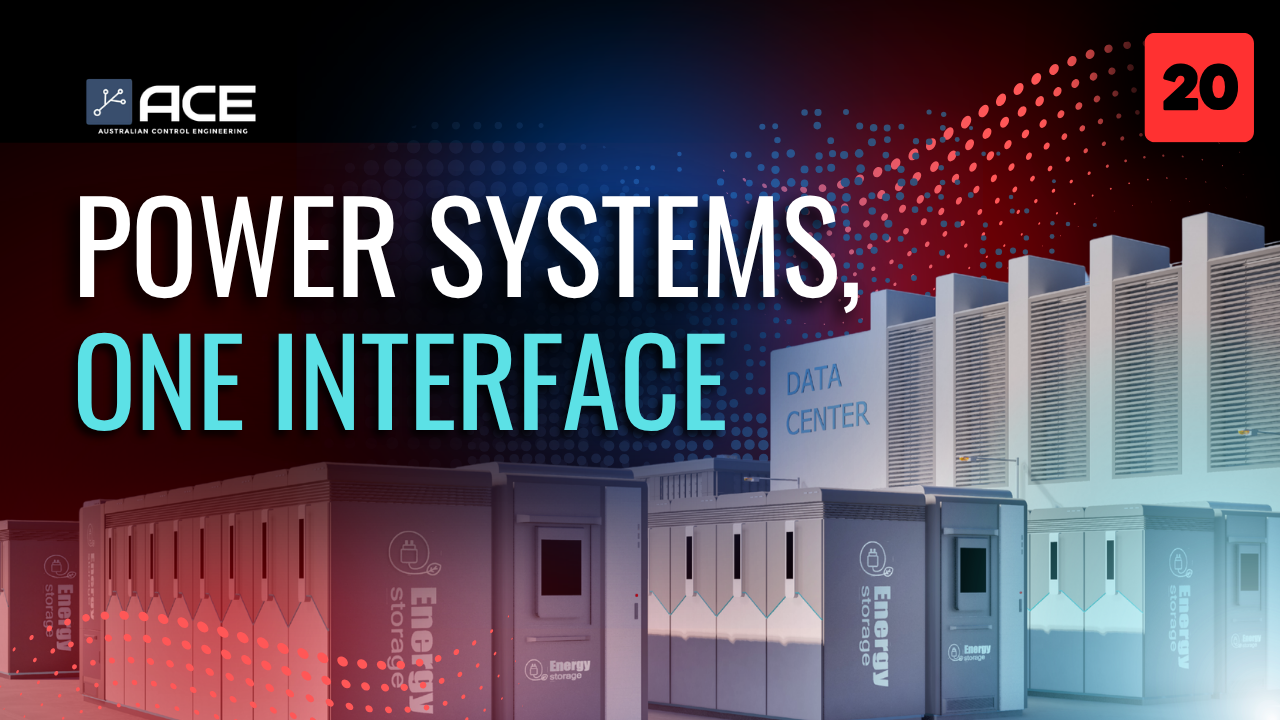
At Australian Control Engineering (ACE), we deliver end-to-end SCADA system integration for Battery Energy Storage Systems (BESS) across Australia — helping renewable energy developers, EPCs, and asset operators unlock real-time visibility, remote control, and performance optimisation.
In a recent live demonstration, our engineering team showcased how a fully integrated SCADA system enables seamless monitoring and control of a BESS — designed to support utility-scale solar infrastructure and grid services. This article walks through how PCS, PPC, and SCADA work together in solar+BESS projects, and the features that matter most for operators navigating Australia's renewable energy market.
Demonstrating Real-World SCADA Integration for Energy Storage
The demonstration was conducted in a lab environment that replicates the operational conditions of a grid-connected solar and battery installation. Using simulated PCS, BMS, and transformer signals, our engineers configured a SCADA system that offers complete monitoring across all key assets in the energy storage stack.
From real-time state-of-charge tracking to thermal status alarms, the system offered full HMI visualisation, automated event logging, and secure remote access — showing exactly how BESS performance can be managed across dynamic grid conditions or dispatch schedules.
The lab-based demonstration also included testing of control logic handshakes between SCADA and PCS inverters, BMS alert propagation, and redundant communication failover — essential features in large-scale BESS deployments across remote or mission-critical sites.
Understanding PCS and PPC in Solar+BESS Projects
Before diving into SCADA features, it helps to understand the two components that make solar+BESS plants work in real time: the Power Conversion System (PCS) and the Power Plant Controller (PPC).
What the PCS Does
The Power Conversion System is the bidirectional inverter at the heart of every BESS. Its fundamental role is to convert DC power from the batteries into grid-compliant AC power during discharge, and AC back into DC during charging. In solar+BESS plants, the PCS sits between the battery strings and the medium-voltage collector network, handling:
- Bidirectional power exchange between the grid and battery storage
- Voltage and frequency regulation at the battery terminal
- Grid-forming or grid-following control, depending on connection type
- Smooth transitions between grid-connected and islanded operation
- Fault ride-through response to grid disturbances
Without robust SCADA integration to the PCS, an operator cannot see charge/discharge rates, real and reactive power output, DC-side voltage and current, or inverter fault codes in real time — leaving a major blind spot in a multi-million-dollar asset.
What the PPC Does
The Power Plant Controller is the brain of the plant. While individual inverters and PCS units handle their local control, the PPC coordinates everything above them to meet grid-code obligations and dispatch targets. A properly configured PPC orchestrates:
- Real-time power output targets for each PCS to meet grid setpoints
- Grid-code support for voltage and frequency response
- Ramp rate control, curtailment, and compliance with network service provider instructions
- Battery state-of-charge management across multiple battery blocks
- Coordination between solar generation and BESS dispatch in hybrid plants
This coordinated control is critical in hybrid renewable power stations where solar, BESS, and sometimes wind or diesel coexist. The PPC is what keeps the whole plant behaving as a single, compliant grid-connected asset rather than a collection of independent inverters.
How SCADA Connects It All
SCADA sits above the PCS and PPC as the monitoring, supervisory, and operator-interface layer. It does not replace the PPC — instead it provides visibility and supervisory control over what the PPC is orchestrating in real time. This distinction matters: SCADA gives operators the insight and alarm response they need; the PPC handles the millisecond-by-millisecond grid compliance.
Smart SCADA Features for Solar+BESS Optimisation
Modern SCADA platforms for solar+BESS plants do far more than show a live dashboard. The features that genuinely move the needle on availability, revenue, and asset life include:
- Real-time state-of-charge tracking — visibility into SoC across every battery block, with drift detection and rebalancing alerts
- Automated charge and discharge scheduling — dispatch logic driven by time-of-use pricing, FCAS market signals, or load forecasts
- Overcharge and deep-discharge protection — software enforcement of SoC windows to extend battery cycle life
- Thermal and cell-health monitoring — tracking module temperatures, cell voltage balance, and state-of-health degradation trends
- Inverter-level monitoring — per-inverter and per-PCS performance data for targeted fault diagnosis
- Automated fault detection and ticket generation — alarms routed directly into the operator's CMMS or ticketing system
- Grid synchronisation and power quality reporting — continuous monitoring of voltage, frequency, and harmonic distortion at the connection point
- Historian and trend analysis — long-term data for performance benchmarking, warranty claims, and degradation analysis
Combined with an effective PPC, these SCADA features ensure that energy output remains stable, compliant with grid codes, and optimised for market participation. ACE delivers turnkey SCADA + PPC solutions tailored for utility-scale solar and solar+BESS projects — you can see our full renewable energy capability on our Clean Energy industries page.
Energy Storage Monitoring for Australian Solar Farms
For Australian solar farms, integrating energy storage is no longer optional — it is essential for dispatch flexibility, grid stability, and FCAS market participation. But the value of a BESS is only fully realised when paired with a robust SCADA and monitoring solution.
Our SCADA platforms allow operators to view live performance data, manage fault events, and automate charge/discharge strategies based on load demand or grid pricing. With compliance built into every level of system design, ACE ensures that storage assets meet AEMO and DNSP operational standards while maximising availability and uptime.
Engineering Services Across the Full Project Lifecycle
ACE's SCADA engineering services go well beyond system deployment. We work with EPCs and developers from the earliest design phases, offering:
- Protocol selection and design — Modbus TCP/RTU, DNP3, IEC 61850, OPC UA
- RTU and PLC configuration
- HMI development with ISA-18.2-aligned alarm philosophy
- Factory and site acceptance testing (FAT/SAT)
- Commissioning and evidence-based handover
- Integration with cloud reporting tools, historians, and third-party platforms
- Long-term remote support and modular expansion
We understand the regulatory environment, utility interface standards, and commissioning timelines that matter in fast-moving clean energy projects.
Why ACE for SCADA-BESS Projects in Australia
ACE has delivered or is actively working on over 2 GWh of BESS SCADA across Australia, making us one of the country's most experienced BESS SCADA integrators. Notable projects include Wagerup BESS (200 MWh) for Alinta Energy and the Glenellen Solar Farm 200 MW with 33kV substation control system designed for future BESS integration.
Our SCADA platforms are built to scale — capable of managing a single battery site or a fleet of assets spread across multiple states. We provide long-term support, remote diagnostics, and modular expansion pathways to align with evolving energy portfolios. Our renewable energy work is underpinned by triple ISO certification (9001, 45001, 14001) and certified system integrator status with Schneider Electric and Siemens.
Frequently Asked Questions
What is a PCS in a BESS system?
A Power Conversion System (PCS) is the bidirectional inverter that connects batteries to the grid in a Battery Energy Storage System. It converts DC from the batteries into grid-compliant AC during discharge and converts AC back into DC during charging. The PCS also handles voltage and frequency regulation, grid-forming or grid-following control, and smooth transitions between grid-connected and islanded operation.
What does a Power Plant Controller (PPC) do in a solar+BESS project?
The PPC is the plant-level brain that coordinates all energy assets to meet grid connection requirements. It sets real-time power output targets for each PCS and inverter, manages ramp rate limits, handles curtailment commands from the network service provider, supports grid-code voltage and frequency response, and coordinates battery state-of-charge management across the BESS. Without a properly configured PPC, a solar+BESS plant cannot reliably meet AEMO connection obligations.
How does SCADA integrate with PCS and PPC?
SCADA sits above the PCS and PPC as the monitoring, supervisory, and operator-interface layer. It collects real-time performance data via protocols such as Modbus TCP, DNP3, or IEC 61850, presents HMI visualisations to operators, handles alarm management and event logging, and provides secure remote access. SCADA does not replace the PPC — it provides visibility and supervisory control over what the PPC is orchestrating in real time.
What SCADA data is most important for BESS operations?
Critical BESS SCADA data points include battery state-of-charge (SoC) and state-of-health (SoH), cell and module temperatures, DC voltage and current, PCS real and reactive power, grid voltage and frequency at the point of connection, alarm and event logs, and cumulative charge/discharge cycles. SCADA should also track time-of-use pricing signals and dispatch instructions from AEMO or the aggregator so operators can optimise revenue alongside technical performance.
Which protocols does ACE use for BESS SCADA integration?
ACE integrates BESS SCADA using Modbus TCP/RTU for PCS and BMS communication, DNP3 for utility telemetry, IEC 61850 for substation automation interfaces, and OPC UA for enterprise integration. Protocol selection is driven by each project's specific vendor stack and network service provider requirements.
Does ACE support 24/7 remote BESS SCADA monitoring?
Yes. ACE provides 24/7 remote monitoring, diagnostics, and maintenance support for BESS and solar+BESS portfolios through secure remote access and the ACE EMS platform. Services include alarm response, performance analytics, firmware and patch management, and proactive detection of degradation trends before they affect availability.
Explore the Future of BESS Control with ACE
This integrated approach to PCS, PPC, and SCADA isn't optional for modern solar+BESS plants — it's essential for competitiveness in Australia's energy transition. Whether you're building a new solar and storage project or upgrading an existing battery site, ACE delivers the engineering, platforms, and support you need for long-term asset performance.
Contact ACE today to discuss how our SCADA solutions can power your next BESS deployment in Australia.